
Location: Kalambaka
Kalambaka is located in the northwestern part of the Thessalian plain. It is built next to the rare geological phenomenon of Meteora, while the Pinios River passes close by.
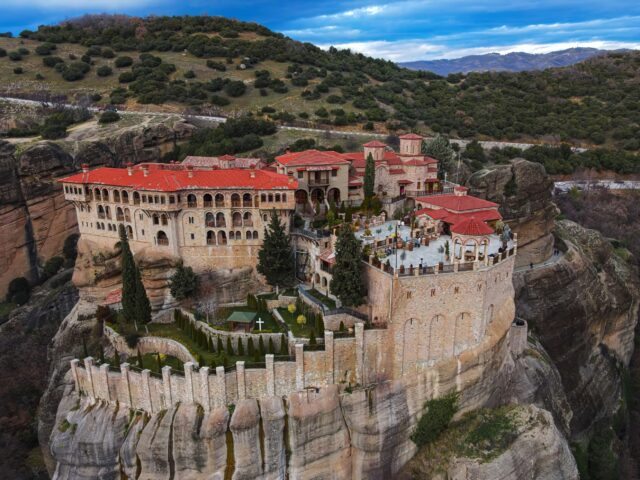
The Monastery of All Saints, commonly called Varlaam, is built on an imposing rock, at the northwestern end of the Meteora stone town of Meteora and in close proximity to the Great Meteoro and the Monastery of Roussanos. The Monastery of Varlaam owes its name to the ascetic-recluse Varlaam, who…
View more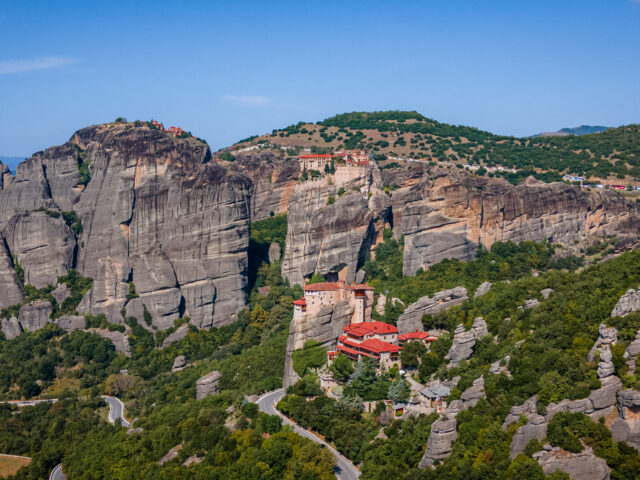
Meteora is one of the most important geological monuments in Greece. It is a complex of impressive rock formations over an area of more than 7 square kilometers, with a height of up to 200 meters and a width that varies, and in some places reaches up to 300 meters….
View more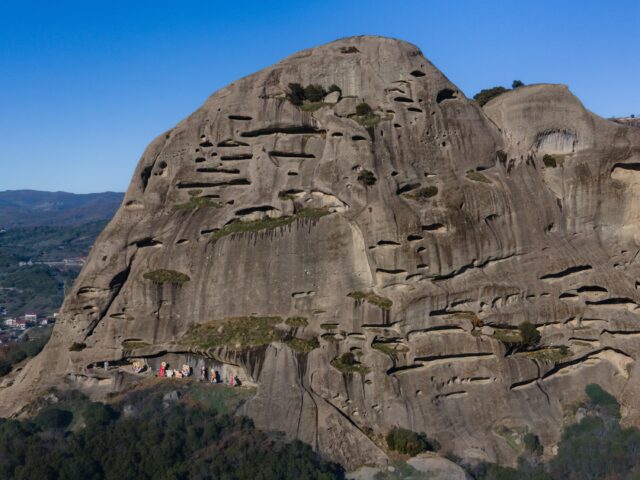
At the western exit of Kalambaka city towards Kastraki, we encounter the rocks “Amparia” and “Bandova” of the Meteora complex. These two rocks are part of the Meteora Conglomerates, which are 10-20 million years old. On the surface of these two rocks we observe the characteristic ellipsoidal cavities called “tafoni”….
View more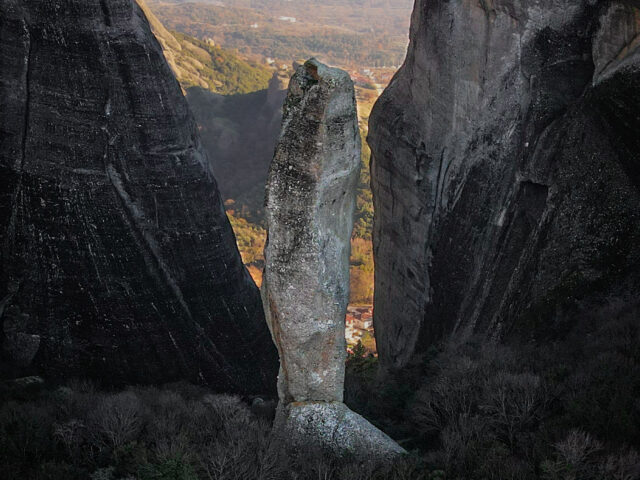
Among the rock formations of Meteora, an impressive styloid rock formation that resembles a stone needle stands out. “Adrachti” (Needle or Spindle) as it has been known through recent history, is a single pillar located south of Kastraki among the large rocks of Meteora, such as Modi and Agia. Meteora…
View more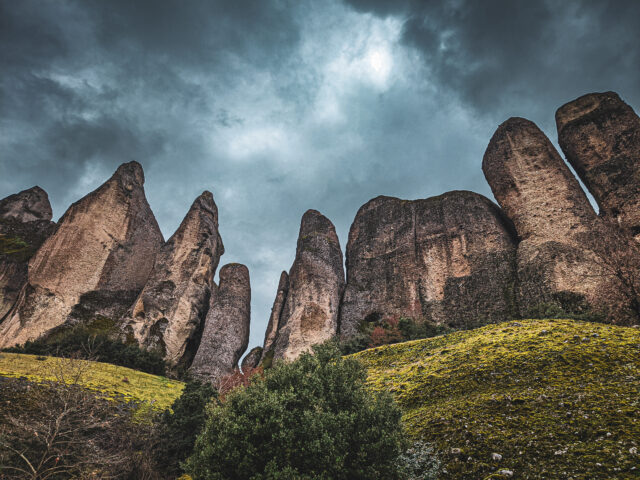
The landforms of Gavros are a continuation of the Meteora complex to the north. The rocky outcrops of cohesive conglomerates and sandstones of the Meteora Conglomerate unit were deposited as submarine drifts and belong to the Meso-Hellenic Trench, as part of the Pentalophos-Meteora Formation of Upper Oligocene – Lower Miocene…
View more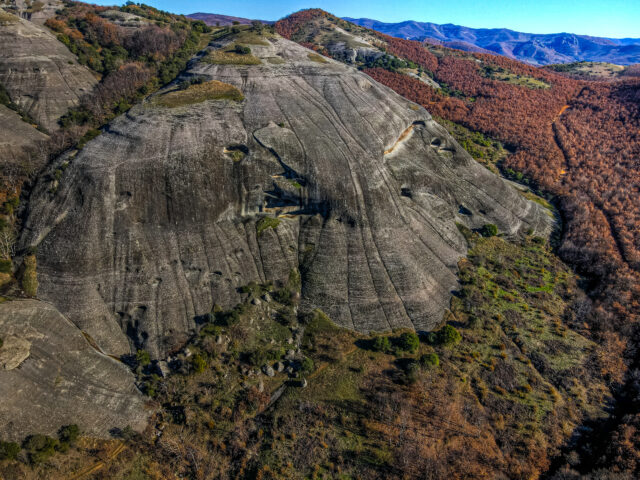
The characteristic rock formations of Agios Dimitrios, Kalambaka, are a continuation of the Meteora complex to the north. On the surface of the rocky outcrops of Agios Dimitrios, erosion processes have created large or small cavities called “tafoni”. The rock outcrops of cohesive conglomerates and sandstones of the Meteora Conglomerate…
View moreSEARCH
Looking for more?
Cras rutrum tellus et vulputate accumsan. Sed id ultricies mauris, nec semper nisl. Morbi quis purus cursus.

